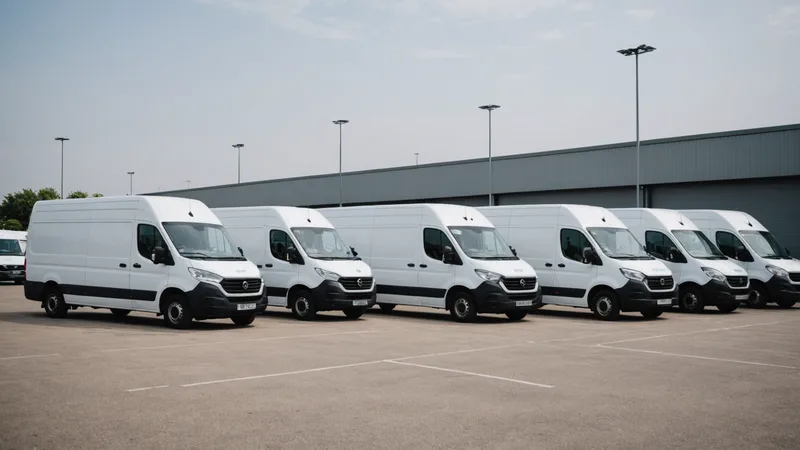
Fleet electrification finance discussions have a predictable shape. The first twenty minutes cover vehicle acquisition cost versus diesel equivalents. The next ten cover charger hardware and installation. Then someone asks about federal incentives, the room gets optimistic, and the meeting ends.
What rarely gets discussed is what happens to the electricity bill eighteen months after the first vehicles go live. That is where the real surprises are. Demand charges, rate structure mismatches, and charging inefficiency compound in ways that the pre-purchase pro forma did not capture. We have seen this pattern repeatedly across early fleet electrification deployments, and it is worth laying out plainly.
The Acquisition Numbers That Get All the Attention
The upfront case for commercial EVs has gotten much stronger. Class 3 and Class 4 electric delivery vans now sit within 15 to 25 percent of diesel purchase price before incentives in most procurement scenarios. When you layer in the Section 45W commercial clean vehicle credit, the gap narrows further. Total acquisition cost over a typical seven-year fleet lifecycle looks reasonable in most models.
Charging hardware adds to that upfront bill. A Level 2 EVSE unit (J1772, 7.2 kW per port) runs between $2,000 and $5,000 installed depending on depot wiring condition. A DC fast charger rated at 60 to 150 kW is $15,000 to $40,000 installed, plus whatever panel upgrade the utility requires. For a thirty-vehicle depot, hardware and installation commonly lands between $150,000 and $350,000 depending on power level chosen.
These numbers are large enough to dominate early planning conversations. They should not dominate the ongoing operational model, but they do, because they are visible and bounded. The electricity cost structure is neither.
What the Electricity Bill Actually Contains
Commercial electricity tariffs for fleet depots typically include at least three distinct charge components: an energy charge (per kWh consumed), a demand charge (per kW of peak draw in a billing interval), and sometimes a facilities or distribution charge. The demand charge is almost always underestimated.
Demand charges on commercial rates vary significantly by utility and rate class. In the industrial and large commercial tier where most fleet depots land, demand charges of $12 to $22 per kW per month are common. Some utilities in high-congestion service areas run higher. The charge is assessed on the single highest 15-minute or 30-minute interval in the billing month.
Here is what that means in practice. A depot running twenty vehicles, each with a 60 kWh battery, all returning from routes between 5 PM and 6 PM and plugging in immediately: if even fifteen of those vehicles charge simultaneously at 7.2 kW each, that is 108 kW of simultaneous demand. At $18/kW, that single charging ramp costs $1,944 in demand charges for the month, regardless of how little power those same vehicles draw during off-peak hours. Repeat that ramp every business day and the monthly demand charge becomes a significant line item even if total kWh consumed is modest.
This is not a theoretical problem. It is the predictable result of letting drivers plug in on arrival without any scheduling logic, which is how most fleets operate for the first year.
The Rate Structure You May Not Be On Yet
Most utilities offer EV-specific commercial rates or time-of-use variants designed for fleet charging. These typically provide substantially lower off-peak kWh rates in exchange for constrained peak-hour charging. Whether a depot qualifies, how the interconnection process works, and what demand charge treatment applies under that rate varies by utility.
The problem is that getting onto the right rate is not automatic. It requires an application, often a load study, and sometimes a metering upgrade. Fleets that start charging before that process completes land on a general commercial rate that was not designed for overnight high-draw loads. They may stay on it for months or longer if no one actively manages the rate migration.
We are not saying the general commercial rate is always worse. Sometimes a fleet's load profile is light enough that the specialized EV rate's demand charge structure actually costs more. The point is that this analysis needs to happen before the first vehicle charges, not after the first few bills arrive.
Maintenance and Battery Degradation: The Long Tail
EV maintenance is genuinely lower than diesel over the vehicle lifecycle. Fewer moving parts, no oil changes, regenerative braking that extends brake pad life. This is real. What gets less discussion is thermal management system maintenance, high-voltage battery health monitoring, and the cost implications when a battery pack degrades outside warranty conditions.
Battery degradation rate in commercial vehicles depends heavily on charging behavior. Consistently charging to 100% state of charge, or regularly allowing packs to sit below 20% for extended periods, accelerates capacity loss. The impact is not immediate. A fleet that started with 120-mile range vehicles may not notice capacity loss until year three or four, when route coverage that worked at purchase starts requiring route reshuffling or mid-day charges that were not in the original plan.
Charging software that targets 80% to 90% daily top-off for most vehicles, with 100% reserved for high-mileage route days, extends pack life meaningfully. The difference between aggressive charging practice and managed charging practice can be measured in percentage points of annual capacity retention, which compounds over a seven-year fleet lifecycle into a real residual value difference at disposal.
Depot Infrastructure and the Utility Interconnection Timeline
One cost category that catches operators off-guard is the gap between expected and actual utility interconnection timelines. For depots adding significant load above roughly 200 kW, utility distribution upgrades may be required. Depending on the service area, that process takes six to eighteen months and may require capital contribution from the fleet operator if the upgrade serves primarily that load.
During that wait, options are limited. Some depots run a reduced number of charging stations. Some operators temporarily route vehicles to third-party charging locations. Both reduce operational efficiency and add costs that do not appear in the original electrification model.
Phased electrification, where a depot converts a portion of the fleet first and stages infrastructure investment to match demand growth, avoids some of this. It also provides real operational data before committing to the full infrastructure scale, which has value given how often actual per-vehicle energy consumption differs from manufacturer specs at the specific routes and loads a fleet runs.
Where the Total Cost Model Should Actually Look
A credible fleet electrification TCO model needs at least five electricity cost inputs: blended kWh rate under the expected tariff, monthly demand charge at projected peak load, demand charge under optimized versus unoptimized charging behavior, the probability and cost range of a utility distribution upgrade, and the revenue impact of any operational disruption during infrastructure buildout.
It also needs a realistic estimate of ongoing charging management overhead. Someone needs to monitor SOC levels, adjust schedules when routes change, and catch vehicles that are consistently undercharging or overcharging. In a small fleet, that is part of the dispatcher's job and often goes untracked. In a larger fleet, it is a meaningful cost center if done manually, and an argument for automated scheduling software.
None of this changes the fundamental direction of fleet electrification. The economics are increasingly favorable, and the operational benefits beyond fuel cost are real, particularly for urban delivery fleets with predictable route profiles. What it does change is the confidence interval around projected savings. A model that ignores demand charges, rate optimization, and charging management overhead will overpromise. The fleets that hit their targets are the ones that modeled the full cost structure before the first vehicle arrived.