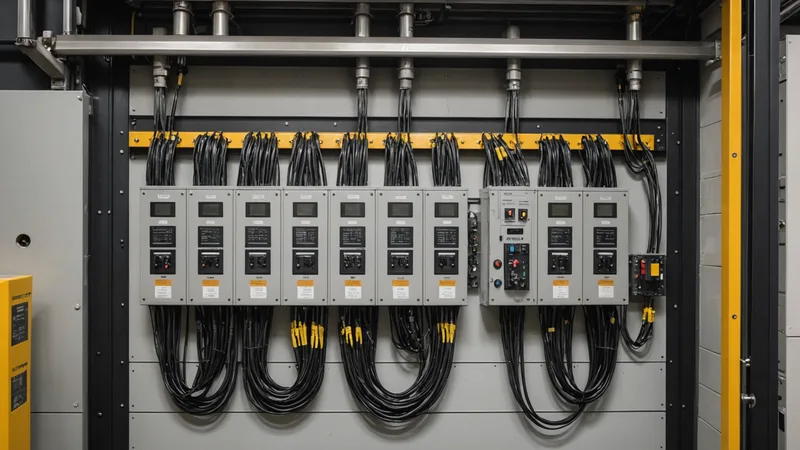
Demand charge spikes at EV fleet depots follow a predictable pattern. Vehicles return from routes within a compressed window, typically one to two hours in the late afternoon or early evening. Drivers plug in. Chargers start simultaneously. The depot's metered power draw jumps by 60 to 150 kW or more within the space of thirty minutes. The utility records that peak in the billing interval, and it sets the demand charge for the entire month.
One peak interval can cost $1,000 to $3,000 in demand charges depending on the tariff and the magnitude of the spike. Repeat it each month and the annual cost is significant. The problem is structural: it follows directly from simultaneous plug-in behavior and does not fix itself without deliberate scheduling intervention.
This article describes three scheduling approaches that reduce demand spikes without compromising vehicle readiness. All three can be implemented with existing OCPP-compatible charger hardware. The appropriate choice depends on depot size, software infrastructure, and how much operational overhead the fleet can absorb.
Understanding What Creates the Spike
A Level 2 EVSE at 7.2 kW draws approximately 30 amps at 240V. Twelve simultaneously active Level 2 stations represent 86.4 kW of simultaneous load. On a 15-minute interval billing period, that sustained draw for the full interval sets a demand of 86 kW. At $17/kW, that one interval costs $1,462 in demand charges for the month.
The key word is simultaneous. The same twelve vehicles, charged across a four-hour overnight window with staggered start times, might never have more than six to eight charging at once. Peak demand drops to 43 to 58 kW. Monthly demand charge drops proportionally. The total kWh consumed is nearly identical (slightly lower due to avoiding some thermal overhead at high concurrency). The operational outcome, every vehicle ready for morning departure, is unchanged.
The objective of demand charge management is not to charge vehicles less. It is to spread the same charging work across more time intervals so no single interval hits a high peak. This is fundamentally a scheduling problem, not a hardware problem.
Approach 1: Fixed Stagger Windows (Manual, Low Infrastructure)
The simplest demand management approach assigns vehicles to staggered charge start times based on depot zone or bay assignment. Group A vehicles (bays 1 to 8) plug in at arrival and charging begins immediately. Group B vehicles (bays 9 to 16) plug in at arrival but charging is delayed 90 minutes. Group C vehicles (bays 17 to 24) are delayed 3 hours.
This can be implemented with time-of-use controls on the EVSE circuits, either through EVSE firmware settings or a simple electrical timer on sub-panels. It does not require OCPP-based software control.
Fixed stagger windows reduce peaks meaningfully on days when vehicles return roughly on schedule. They fail on days when vehicle return times are irregular: Group A vehicles that return late get compressed charge time, Group C vehicles that depart early may not complete their charge before the delay expires. The approach also applies delay uniformly regardless of which vehicles need priority charging that day.
We are not dismissing fixed stagger windows as useless. For a small depot with ten to fifteen vehicles and fairly consistent return times, it is a practical first step that requires no software investment. It is a starting point, not a long-term solution.
Approach 2: Power Cap with OCPP Smart Charging Profiles
OCPP 1.6 and later support Smart Charging profiles that allow a charge management system to set a maximum power budget for the depot and distribute available capacity across active sessions. When total active charger draw approaches the power budget ceiling, the system throttles individual sessions rather than cutting them off, keeping all vehicles charging but at reduced rates distributed across the active population.
This approach requires OCPP-compatible charger hardware and a charge management system or energy management controller that supports OCPP Smart Charging. Configuration involves setting a depot-level power budget (for example, 80 kW maximum simultaneous draw) and allowing the system to allocate that budget dynamically across active sessions.
The practical behavior: when twenty vehicles arrive and connect simultaneously, each receives 4 kW instead of 7.2 kW. As vehicles complete their charge and sessions close, the remaining active sessions can ramp back to full rate. Peak demand is capped. All vehicles continue charging. Vehicles that arrived with lower SOC will charge more slowly on the congested evening ramp and may take longer to complete, but with adequate overnight time most fleet depots have enough window for all vehicles to reach target SOC even at reduced rates.
The OCPP power cap approach is the most widely deployable option for fleets with existing OCPP hardware. It does not require per-vehicle route data or prediction; it operates purely on real-time power draw versus budget. Its limitation is that it does not prioritize vehicles that genuinely need charge urgently versus those that could afford a longer low-rate session. Dynamic throttling distributes capacity somewhat equally rather than smartly.
Approach 3: Priority-Based Dynamic Scheduling
The most effective demand spike reduction comes from schedule-aware charging that knows both the depot power budget and each vehicle's actual charge requirement and departure time. This is what we built Fleetvolts to do.
The scheduler runs after vehicles arrive and charge states are captured. For each vehicle, it knows the current SOC, the required SOC by departure time (based on tomorrow's route), and the available charging window. It also knows the depot power budget and the current electricity tariff, including which overnight hours are off-peak and therefore cheaper.
With that information, it builds an overnight schedule that sequences vehicle charging to keep simultaneous depot draw below the demand target, prioritizes vehicles with urgent charge needs, delays vehicles that have adequate time and moderate charge requirements, and shifts as much charging as possible into off-peak tariff windows to reduce energy cost simultaneously with demand cost.
The outcome is different from fixed stagger and power-cap approaches in an important way: vehicles are treated individually. A vehicle returning at 4 PM with 20% SOC and a 7 AM departure on a 90-mile route charges immediately at full rate. A vehicle returning at the same time with 65% SOC and a 9 AM departure on a 45-mile route is scheduled to begin charging at 10 PM in the off-peak window. The first vehicle's urgency does not delay the second vehicle's readiness, and the second vehicle's charge start is deferred to a time that both reduces demand and reduces energy cost.
Choosing the Right Approach for Your Depot
The right approach depends on fleet size, existing hardware, and the magnitude of the demand charge problem. For depots under twelve vehicles on a flat-rate tariff with modest demand charges: fixed stagger windows may provide adequate benefit without software investment. For depots of twelve to thirty vehicles on a commercial tariff with significant demand charges and OCPP-compatible hardware: OCPP Smart Charging with a power cap is a practical near-term solution that can be deployed quickly. For depots above twenty vehicles or any depot where route variability is high: priority-based scheduling that incorporates vehicle charge requirements and departure times produces materially better outcomes than either static approach.
The fixed cost of demand charge overexposure scales with fleet size and duration. A twenty-vehicle depot paying $1,800 per month in avoidable demand charges is spending $21,600 per year for a problem that has available solutions. That number is worth keeping in mind when evaluating the cost and complexity of each approach.
Whatever approach a depot implements, the first step is measuring the current demand profile. Pull sixty days of 15-minute interval data from the utility or from a sub-metering device on the EV charging panels. Identify the peak interval times and magnitudes. That data establishes the baseline demand charge exposure and tells you exactly when and by how much the spikes occur, which is the information needed to design any effective response.